

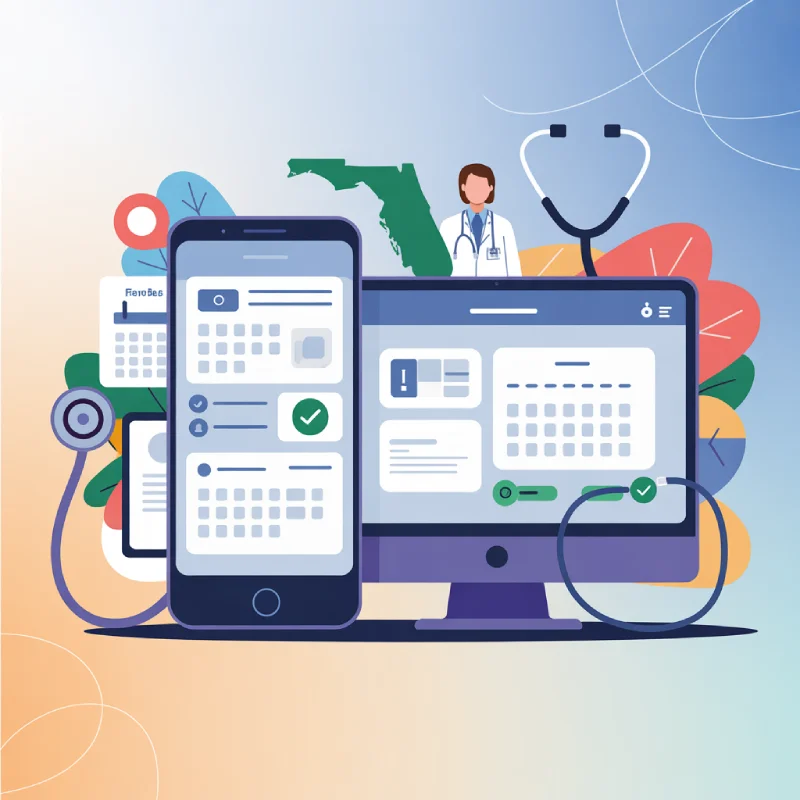
Florida healthcare website design experts improve online appointment scheduling by creating streamlined booking interfaces with minimal clicks, real-time availability displays, ADA/HIPAA compliance, mobile-responsive layouts, and seamless integration with patient portals and electronic health records.
Online appointment scheduling serves as the digital front door to healthcare services, determining whether patients can easily access care or abandon the booking process in frustration. In Florida's competitive healthcare market, website design experts implement strategic improvements that transform complex scheduling systems into intuitive, secure, and accessible patient experiences that drive appointment bookings and reduce administrative burden.
Key Takeaways
- Streamlined booking interfaces with minimal clicks and real-time availability displays reduce patient friction and increase appointment completion rates
- ADA compliance features, including screen reader compatibility and keyboard navigation, ensure all patients can independently schedule appointments
- HIPAA-compliant encryption and access controls protect sensitive patient data throughout the scheduling process
- Mobile-responsive layouts accommodate on-the-go scheduling needs, capturing 39% of appointments booked through digital channels
- Integration with patient portals and EHR systems enables seamless data synchronization and reduces manual entry errors
Designing Intuitive Booking Interfaces That Put Patients First
An effective healthcare booking interface determines whether individuals can easily access services or abandon the process in frustration. Florida healthcare website design experts prioritize streamlined appointment paths with minimal clicks, real-time availability displays, and visual progress indicators that guide patients through each step.
Mobile-responsive layouts ensure touch-friendly buttons and fonts work seamlessly across devices, while accessibility features like screen reader compatibility support patients with disabilities. Artificial intelligence integration enables adaptive forms that adjust based on patient inputs, reducing unnecessary questions and streamlining the booking experience.
Meeting ADA and HIPAA Standards for Secure Healthcare Scheduling
Healthcare scheduling platforms in Florida must simultaneously address two critical regulatory frameworks: ADA accessibility standards that ensure all patients can independently book appointments regardless of disability, and HIPAA requirements that safeguard sensitive health information throughout the scheduling process.
Organizations with 15 or more employees face a May 2026 deadline to ensure their scheduling systems meet WCAG 2.1 AA standards, while smaller practices have until May 2027 to implement these accessibility requirements. Integrating both compliance frameworks creates scheduling systems that are legally defensible and deliver equitable, secure experiences for every patient.
ADA Compliance Design Features
Digital accessibility in medical appointment systems ensures that patients of all abilities can independently schedule, modify, and manage their healthcare visits without encountering barriers. Healthcare website designers implement screen reader integration throughout scheduling workflows, ensuring proper HTML labeling on form fields and confirmation messages.
- Screen reader compatibility with proper HTML labeling on all form fields and buttons
- Keyboard navigation functionality eliminates reliance on mouse interactions
- Color contrast ratios maintain 4a .5:1 minimum for text and interface elements
- Alternative text descriptions accompany all images, icons, and buttons
- Clear error messages with specific instructions for correcting input mistakes
- Consistent navigational patterns establish logical tab orders through multi-step processes
HIPAA Data Protection Measures
Secure healthcare scheduling platforms must protect patient information through rigorous technical safeguards that satisfy HIPAA requirements. Florida healthcare website design experts implement TLS 1.2 for data transmission and enforce AES-256 for stored patient records.
Role-based access management ensures staff members view only the appointment data necessary for their specific responsibilities. Multi-factor authentication strengthens password protection, while automated audit trails document every access event with timestamps for compliance verification.
Connecting Appointment Systems With Patient Portals and Medical Records
When patients can schedule appointments, view medical records, and communicate with providers through a single integrated platform, healthcare delivery becomes more efficient and patient-centered. Florida healthcare website design experts prioritize seamless integration between appointment systems, patient portals, and EHRs to create unified digital experiences.
Benefits of System Integration
- Centralized patient data allows providers to access appointment history, treatment plans, and medical records from one secure location
- Real-time synchronization ensures appointment updates automatically reflect across all systems
- Enhanced communication through secure messaging connects patients directly with care teams
- HIPAA-compliant architecture safeguards sensitive health information with encryption and access controls
- Reduced no-show rates through automated reminders and improved care coordination
Structuring Website Navigation to Make Scheduling Effortless
Florida healthcare websites must prioritize intuitive navigation that minimizes barriers to patient appointment scheduling. Effective design places "Request Appointment" buttons in highly conspicuous locations throughout the site and establishes clear hierarchical pathways to booking interfaces.
This navigational structure ensures patients with varying technical abilities and accessibility needs can effectively locate and complete scheduling tasks without unnecessary clicks or confusion.
Strategic Navigation Elements
| Navigation Element | Implementation Strategy |
| Button Placement | Above the fold with consistent placement across all pages |
| Visual Design | Contrasting colors, adequate white space, and calendar icons |
| Mobile Optimization | Touch-friendly sizing with sticky bottom bars for constant access |
| Accessibility Features | Screen reader compatibility and keyboard navigation support |
Enhancing Mobile Accessibility for On-the-Go Appointment Booking
A mobile-responsive layout positions critical booking functions within thumb-friendly zones, eliminating precision-dependent calendar interfaces that frustrate single-handed users. Streamlined pathways reduce form complexity to three essential fields with autofill capabilities, collecting only service and location data before displaying real-time appointment availability.
According to guidance from the U.S. Department of Health and Human Services, mobile device security is essential for protecting patient health information in healthcare applications. Page load times under two seconds on 4G connections through optimized compression capture 43% of patients searching outside business hours.
Using Analytics to Identify and Eliminate Scheduling Barriers
Behind every abandoned booking attempt lies quantifiable friction that analytics transforms into actionable improvement opportunities. Florida healthcare website design experts deploy predictive analytics to examine patient data, revealing patterns in no-shows, cancellations, and scheduling conflicts.
Analytics excel at detecting scheduling bias patterns across demographics, identifying underserved patient populations facing accessibility challenges. Monitoring patient interaction with self-scheduling tools reveals usability issues and drop-off points requiring interface improvements.
Key Analytics Applications
- Tracking form abandonment rates to identify friction points in booking workflows
- Analyzing appointment utilization rates to expose underused slots and staffing inefficiencies
- Monitoring behavioral data to refine scheduling protocols continuously
- Identifying demographic patterns to address accessibility challenges
- Optimizing staffing resource utilization by balancing provider schedules against demand predictions
Implementing Automated Reminders and Communication Tools to Reduce No-Shows
Florida healthcare website design experts implement automated notification systems that reduce no-show rates by up to 38% through multi-channel communication strategies. These systems integrate bidirectionally with EHR platforms, enabling real-time appointment updates while maintaining HIPAA compliance through captured patient consent preferences.
Effective Automated Communication Tools
- Multi-channel delivery using SMS (98% open rate), email for detailed instructions, and voice-based options for accessibility
- Custom notification templates with patient-specific details and localization to reduce confusion
- AI-powered optimization that sends notifications at ideal times based on engagement data
- Analytics dashboards tracking delivery rates and no-show patterns by communication channel
How Florida Medical SEO Transforms Your Appointment Scheduling Experience
Florida Medical SEO specializes in developing comprehensive appointment-scheduling solutions that prioritize the patient experience while maintaining strict compliance standards. Our healthcare website design company in Florida creates intuitive booking interfaces with seamless EHR integration, mobile optimization, and advanced security measures that protect patient data throughout the scheduling process.
Beyond website design, our Florida medical SEO services ensure your appointment scheduling system ranks prominently in local search results, capturing patients actively seeking healthcare services. We implement analytics tracking to continuously identify and eliminate scheduling barriers, deploy automated reminder systems to reduce no-shows, and ensure complete ADA and HIPAA compliance to protect your practice while serving all patients equitably.
Frequently Asked Questions
What is the most important feature of an online appointment scheduling system?
The most important feature is intuitive user experience combined with real-time availability displays. Patients need to see available appointment slots immediately and complete bookings in three clicks or fewer. Systems that require excessive form fields or lack mobile optimization experience abandonment rates exceeding 60%, while streamlined interfaces increase appointment completion by 35-50%.
How do healthcare websites ensure appointment scheduling is HIPAA compliant?
HIPAA-compliant appointment scheduling requires end-to-end encryption using TLS 1.2 protocols for data transmission and AES-256 encryption for stored patient records. Systems must implement role-based access controls, multi-factor authentication, comprehensive audit trails, and Business Associate Agreements with third-party vendors. Only minimal necessary information should be collected during the initial scheduling process.
Why is mobile optimization critical for healthcare appointment scheduling?
Mobile optimization is critical because 39% of healthcare appointments are now booked through digital channels, with 80% of those bookings occurring on mobile devices. Additionally, 43% of patients search for healthcare services outside business hours when mobile access is most convenient. Mobile-responsive designs with touch-friendly interfaces and page load times under two seconds significantly increase appointment booking rates.
How can automated reminders reduce no-show rates?
Automated reminders reduce no-show rates by up to 38% through multi-channel communication strategies. SMS messages achieve 98% open rates, while email provides detailed appointment instructions. Systems that send reminders at AI-optimized times based on patient engagement data and allow easy rescheduling through reply messages demonstrate the highest effectiveness in reducing missed appointments.
What accessibility features are required for ADA-compliant appointment scheduling?
ADA-compliant appointment scheduling requires screen reader compatibility with proper HTML labeling, keyboard navigation functionality, color contrast ratios of 4.5:1 minimum, alternative text for all visual elements, and clear error messages. Organizations with 15+ employees must meet WCAG 2.1 AA standards by May 2026, ensuring all patients can independently book appointments regardless of disability.
Conclusion
Florida healthcare website design experts significantly improve online appointment scheduling by prioritizing patient experience while maintaining strict compliance standards. Through intuitive interfaces, robust security measures, seamless system integration, and mobile optimization, healthcare providers can reduce scheduling barriers and no-shows while increasing appointment conversion rates and overall patient satisfaction.
Ready to transform your appointment scheduling system into a patient acquisition engine? Contact Florida Medical SEO today for a comprehensive scheduling system audit and customized design strategy that converts website visitors into booked appointments.